"The solution is to be found through the sanctification of the parents. Become saints and you will have no problems with your children." Father Porphyrios , Wounded By Love

Friday, March 29, 2013

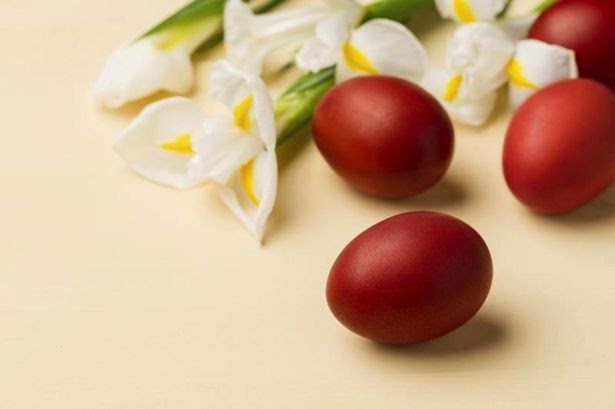
Lent Crafts: Pascha Candles

In our parish, we try to offer a small craft related to Great Lent and Pascha each year. This year we have chosen to invite parents to decorate a "Lambatha, or Pascha Candle" with their children after the celebration of a Divine Liturgy on Sunday. Often these can be purchased with stuffed animals and ribbons, but we aim to use small icon stickers, wax decals, and symbols from our faith instead. Beeswax is an ideal offering, however white is also fitting for the Resurrection if this is what your parish offers.

Here are a few symbols to incorporate:
A small icon of the Resurrection
A Cross
Three Crosses
Alpha and Omega
Flowers
IC XC NIKA (Jesus Christ Conquers)
The "X" and P"
Christ is Risen


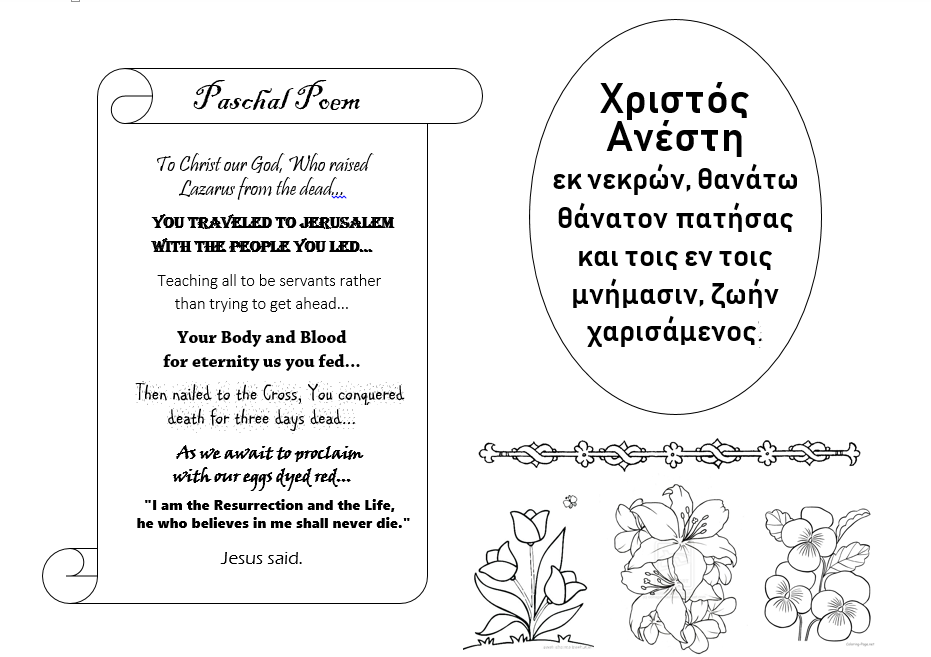
Here is a sample graphic to print on labels. If anyone else has done this craft before, please share your advice. I found the following links that were helpful:

http://festalcelebrations.wordpress.com/2008/02/13/baptismal-and-paschal-candles/

Secondly, a thought was offered to decorate the small plastic cup that is often used to catch the wax from burning little hands.

Or thirdly, you could decorate a small white lantern to take the "Holy Fire" home. This is helpful protection from the wind as well during processions!

Wednesday, March 27, 2013

4th Sunday of Great Lent Curriculum


This is an example of how I will compile our lessons from the Sundays of Great Lent 2011. I regret not doing it sooner, but so many ideas came forth from actually teaching.
Click here to download the PDF for free: 4th Sunday of Great Lent Curriculum
May it be of some assistance to you next year! 

Please see the corresponding Great Lent Curriculum Chart and Great Lent Workbook containing the coloring icons.

Your comments and suggestions are always welcome,
E-mail me if you prefer.

Friday, March 8, 2013

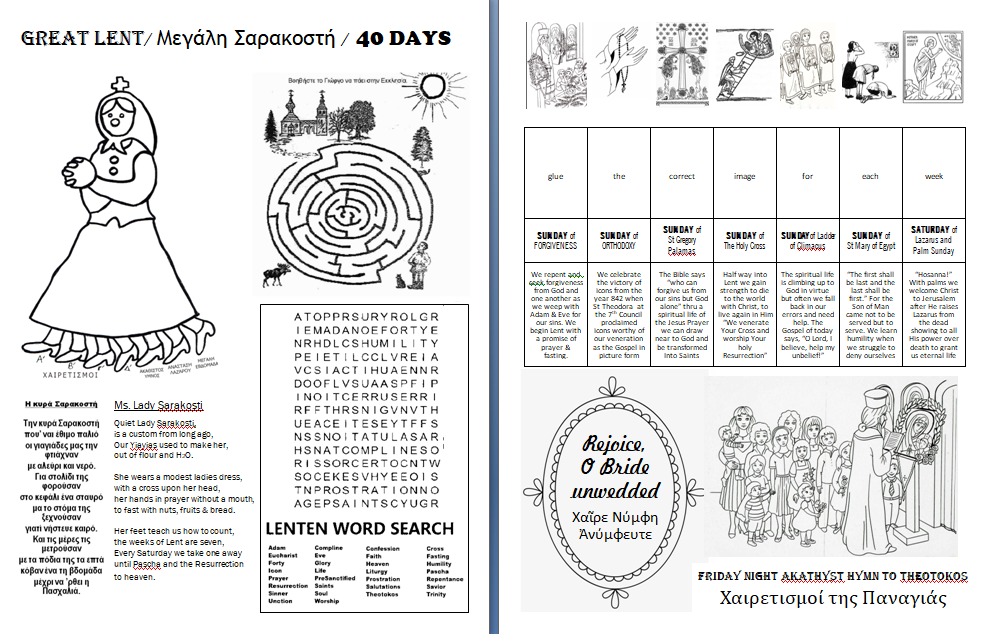
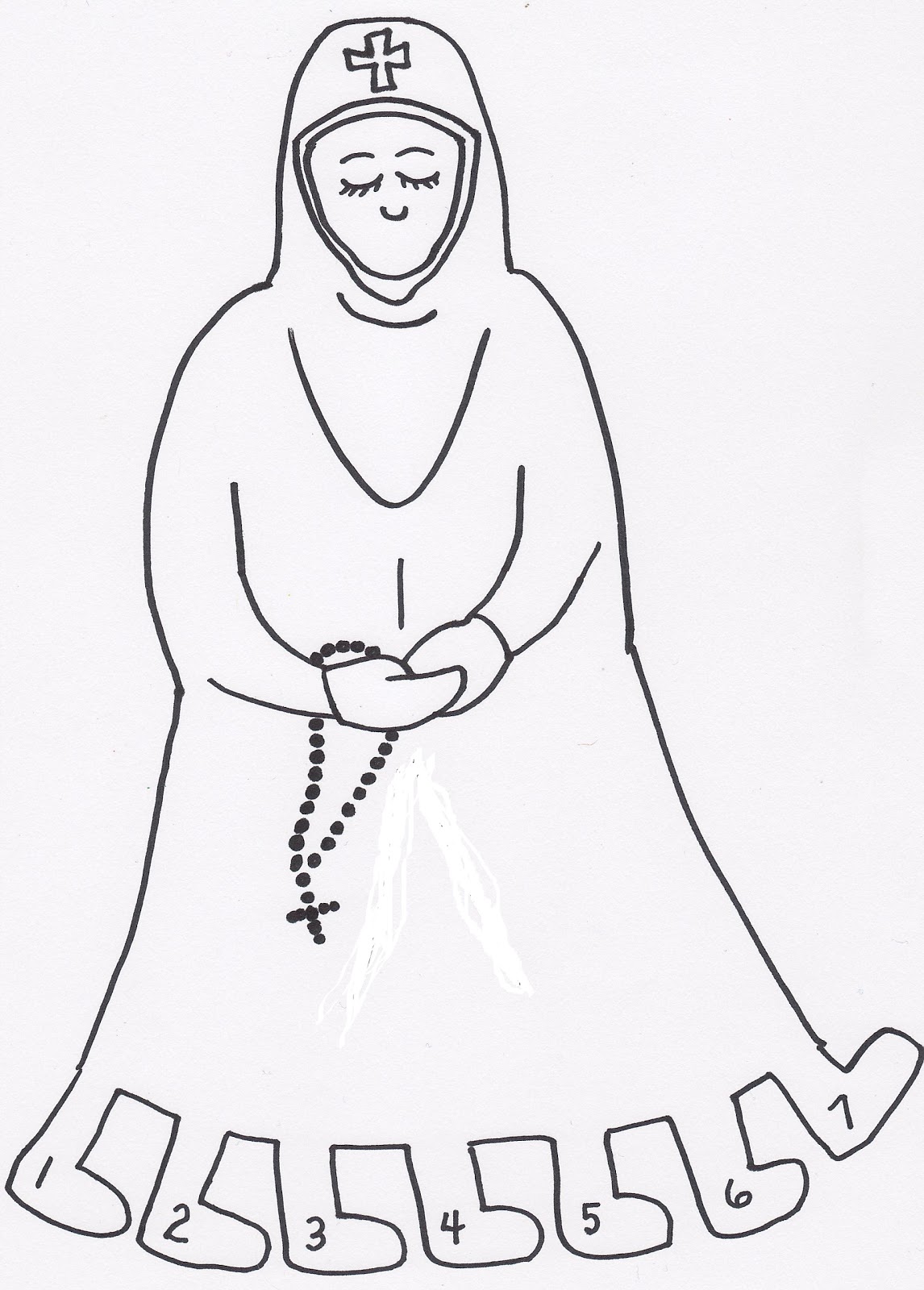
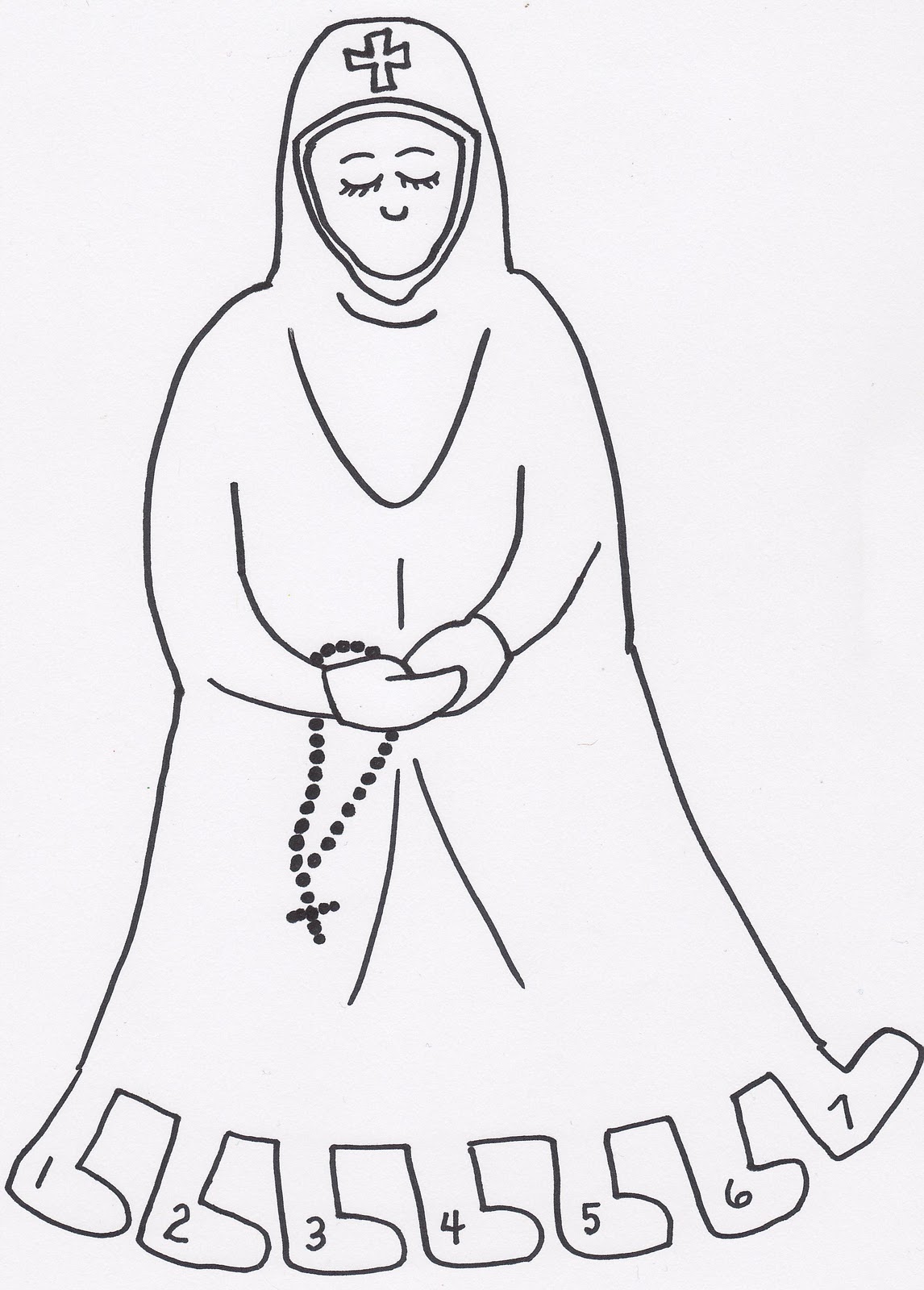
Lady Sarakosti Poem & Coloring for Great Lent


Quiet Lady Sarakosti, is a custom from long ago,
Our grandmothers used to make her, out of flour and H2O.

She wears a simple nun’s dress, with a cross upon her head, her hands in prayer without a mouth, to keep the fast with mostly bread.

Her feet teach us how to count, the weeks of Lent are seven, we cut one off each Saturday, until Pascha and the new heaven.

**If you make a better translation of the original Greek poem, please share it! This is also my version of a more Monastic Lady Sarakosti drawing with a prayer rope in hand and head veil**

Lady Sarakosti Recipe
2-2 1/2 cups flour
1/2 cup salt
2-2 1/2 tsp. cinnamon                            
water (as much as needed)        
* Not to be eaten! *

Combine flour, salt and cinnamon in a medium sized bowl and gradually add enough water to form a stiff, but flexible dough. Roll dough out to 1/2" thickness. With a sharp knife cut out the figure as shown above. Cut out two long narrow strips for arms and join at shoulders (wet surface to which arms will be applied). Make slits in dough for fingers.  Mark closed eyelids and noise with pointed object. Wipe entire figure down with a lightly dampened cloth to make shiny. Bake in moderate oven until golden.

Orthodox Coloring Books for Lent

The time has come for Great Lent 2012 - here are some extra resources to challenge your young ones! We have compiled a printable PDF workbook available for free at this Scribd link. It contains coloring icons, games and craft activities to accompany the Sundays during Lent as well as Lazarus Saturday and Holy Week. Please do not reproduce or sell this for profit in any way - it is simply available for parish and home use only.


To purchase other fantastic resources available in many languages visit http://orthodoxchildrensbooks.com. Potamitis Publishing has extremely reasonable prices which include even the cost of shipping! They have informed me that the workbooks
have nice explanations on each page in both Greek and English for example.


I wish you all a fruitful journey this year, with many blessings and illumination for a glorious Pascha celebration!

Wednesday, March 6, 2013

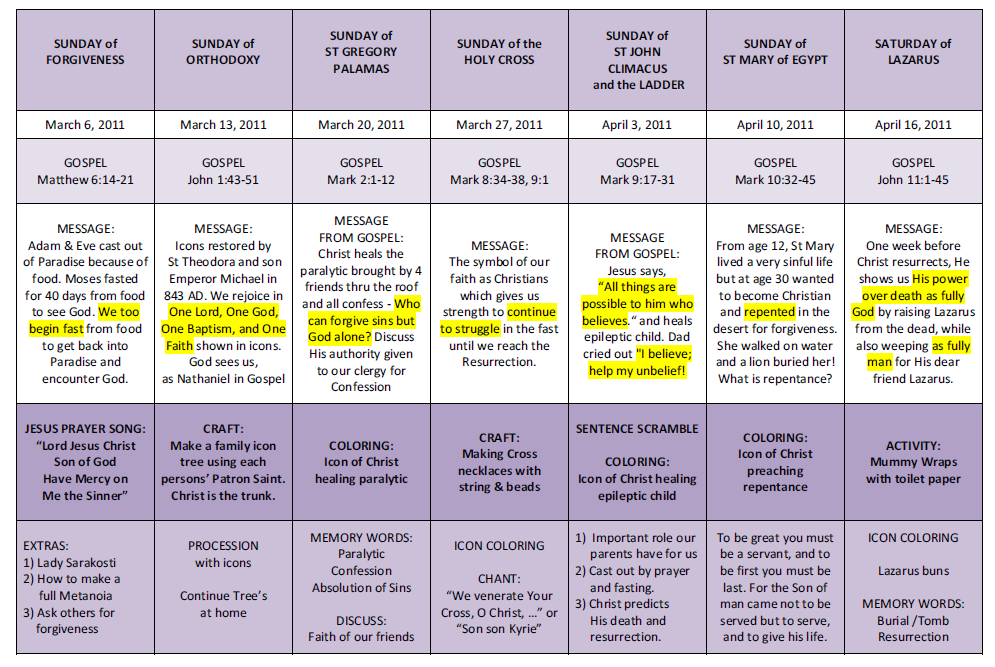
Great Lent Curriculum


For those interested, I'm re-posting a lesson plan chart and soon to follow workbook pages for Great Lent. The lessons are designed for each Sunday leading up to Holy Week, for a brief 1/2 hour immediately after the Divine Liturgy. Since other adults will be present to help in our situation, we're teaching the same lesson to kids ranging from 2 to 10 years of age.
    
Each session will include either a craft, coloring page, memory words, activity or hymn to chant. Every child will create necklace name tags on the first day, and decorate folders with fasteners inside that will become their workbooks. They only take home their craft each Sunday, as I will hold on to their folders until the end and add pages for Holy Week with Pascha.
     
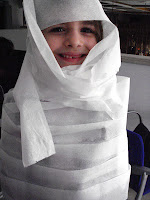
So far, I'm really looking forward to creating the "Family Icon Tree's" and Mummy Wraps with toilet paper for the raising of Saint Lazarus! If you have other ideas I can include, please pass them along! I'll be converting this whole chart to Greek as well if anyone needs that.

Stay tuned for a follow-up PDF and SCRIBD link to download the workbook pages.

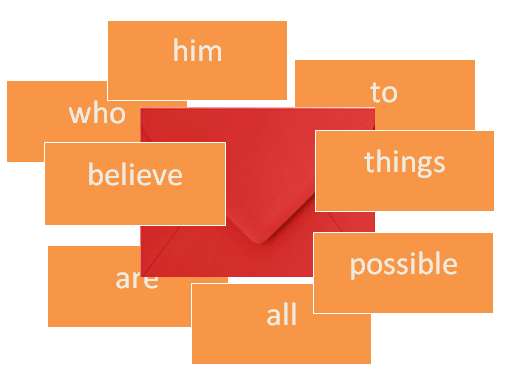
UPDATE: I've recently added a sentence scramble activity for the older ones in the group. Basically, seal envelopes with words from at least two memory phrases and ask the kids to work in groups to put the phrase together. This will work well on the Sunday of St John Climacus.

Saturday, February 23, 2013

Thursday, February 21, 2013

Discovering Virtue


Here is a new workbook on "Discovering Virtue" for our Orthodox youth, probably at a pre-teen or teenage level. I offer it with hopes that it will provide a basic framework to discuss the spiritual life and difficult topics like chastity, humility and obedience,along with activities, a craft, and quotes from the desert fathers.

The document can be viewed as a PDF by clicking here at our Orthodox Education Scribd Group

If you have ideas to develop this lesson further, please share them either through this website of by emailing me at eleniemarie@gmail.com

The icon on the cover is one of many beautiful crafts offered at the Monastery of St John Chrysostomos

"You have to struggle to increase your zeal for God. It should become for you a daily way of life. Struggle for perfection. If you can't gain a drachma, gain at least a tenth of a drachma. Virtues are not acquired easily. There is need of struggling. And know: if we acquire virtue quickly, we shall lose it quickly. Whereas if we acquire it with labor, it doesn't go away."

-Blessed Elder, IERONYMOS of Aegina +1966

Saturday, February 2, 2013

Icon Family Tree

If you haven't created your very own "Family Icon" consider doing so with your children or Sunday school classes.  First we printed out the tree design and colored it, then we trimmed and added our icons of the Patron Saints for each member of the family. We cut the icons out of old catalogs and calendars we had. An icon of Christ was centered in the trunk of the tree, as we added the words of Christ in Greek - "I am the true vine + Ye are the branches" below. We had a little too much fun with the glue and glitter, then mounted it on construction paper, with two holes and string at the top. It hangs as a sort of a tapestry in our home. If you'd like, you could also write at the top "God bless the _______ Family."

For us, it has been a joy for our children to learn who they are named after. We have the habit of asking our kids, "Who has the name from Agios Vasilios? Who has the name from Panagia? From Saint Helen, and Saint Stefanos"  (our Family Icon needs an update with the birth of our daughter last year!)

We hope our tree will continue to grow outwards and spiritually upwards!

The Way We Worship

(re-posted) On the feastday of St John Chrysostom, we'll not only discuss his life and contributions but we're planning to introduce our children to the way we worship and more importantly, why we worship the way we do in the Orthodox Church. Below are some talking points for the lesson, as well as a coordinating activity or craft.

1. When we enter the Church, we try to leave behind the cares of the world. School, Homework, Chores, Tomorrow, What's for dinner....etc. Beginning in the Nave (like a boat in the "Navy") we travel closer and closer to God during the service.

2. Each week, we worship the same way and celebrate the Divine Liturgy of St John Chrysostom from the 5th century. The word "liturgia" literally means "work of the people." By attending the Divine Liturgy, we are choosing to give back this time to God.  This is our "work." We offer our gifts to Him - our time, our attention, our prayers, our voices. and more tangibly the wine and bread, made with our own hands from the very gifts that God has given us - grapes and wheat.

3. Everyone in the Church is united by a common Baptism and confession of faith. We are a family, surrounded with the Angels and Saints in heaven. We worship God in the Orthodox Church with all of our senses in order to fully participate with our mind, body and soul.


Activity - Ask the children to correctly match the ways we worship God with our senses- if possible, they can make the drawings themselves on colored paper, or you can cut and paste from pictures
  • Ears - We hear the word of God in the Gospel and Epistles readings 
  • Voices - We chant the praises of the angels 
  • Hands- We form the sign of the life-giving Cross 
  • Nose - We smell the incense as an offering of our prayer rising to heaven 
  • Body - We bow our heads, bend to the ground and kneel to worship God 
  • Eyes - We see the light of Christ in every candle and focus our prayers to the windows of heaven, the icons.
  • Mouth - We taste the very Body and Blood of Christ

4. Lastly, let us not forget that the Divine Liturgy is for the whole world, and through this special service, God helps and saves His creation. We not only say prayers for the weather, for our food and crops, for our protection from danger and for a faithful life, but we pray for the "peace of the whole world." Although our local Church may not offer a Divine Liturgy everyday, don't forget that in monasteries around the world, the Divine Liturgy is being offered daily, without stop, as a constant prayer to God.

"A Russian priest was speaking with a minister of another denomination one day. The later spoke at great length about all the wonderful things that his church did for the poor and the environment through service projects, soup kitchens, volunteering, and the likes. Then he asked the Russian priest what the Orthodox people do? And the Russian priest paused quietly for a moment, and simply responded, we do the Divine Liturgy."    

Monday, January 28, 2013

A Baptism Toast

"The common thing that brings all of us together, is our love for _______, and our desire to offer her/him the best beginning. Think about all the things we do for the newest member of our family...we make a safe home, with a safe bed and a safe car seat for her/him. We take her/him to the doctor for vaccinations and care for her/him to the best of our abilities, without her/him ever asking for it, but just because we love her/him. This is exactly the reason why we bring her/him to the Church today.

Today, we offer ______ the beginning of a life grounded in the principles of faith,  kindness to others, and love for herself/himself as God's most important creation. She/he will be able to grow up with the best medicines for her/his mind, body and soul because she/he will begin receiving the holy Sacraments. Today, she/he was sealed with the chrism of the Holy Spirit, her/his hair was cut as her/his first offering to God, and she/he was clothed in the armor of new baptismal clothes with the symbol of the holy cross that will be her/his strength against all of life's challenges. She/he received the name of a great Orthodox Saint, whom will serve as__________'s role model in a world where young girls/boys struggle to find a holy example of chastity, true beauty/love and charity.

Lastly, did you know that today she/he also received her/his guardian angel, whom we might not see but whom we can believe is with her/him, protecting her/him especially when we cannot!

For all these reasons, we thank you for being with us today and for your prayers. We ask that you don't forget our ________ as we return to the busyness of life, but that each of us remember our responsibility to offer ________ the very best of a Christian life."

Tuesday, January 22, 2013

Confession & Kite Day


In 2013, Clean Monday is on March 18th. If your parish has never held a day to invite all the children, big and small, to experience the Sacrament of Confession....keep reading! This year, we're planning ahead and beginning our preparations. The tradition in Greece is to fly kites, which may to some appear secular, but when looked at more closely, can have a beautiful relation to the soul! You see, on the Sunday evening before we begin Great Lent, there is always held the Vespers of Forgiveness where each parishioner asks the priest and one another for forgiveness. It marks the beginning of a great journey in which we embark to clean our souls of the darkness built up from our sins. Consider gathering your youth (ages 2-18) and even their parents to a day set aside for Confession and Kite Flying!

We've chosen the Saturday beforehand. The younger children can experience Confession as a group with the priest, who can speak with them openly about the topic of sin and all can kneel under the "epitrahelion" for the final absolution to conclude, whereas the older kids can prepare their confession ahead of time and meet with the priest one on one. As each group finishes, we plan to meet outside to hand out free kites and experience the "joy" of a soul released to soar!

Here is my simplified Top 10 Preparation List http://orthodoxeducation.blogspot.de/2008/06/weight-of-our-sins.html 

Additional Resources :
http://orthodoxinfo.com/praxis/pr_confession.aspx

Pamphlet with Questions for Preparation:
http://orthodoxinfo.com/praxis/guide-to-confession.aspx

Friday, December 28, 2012

St Basil: At a Time of Need


Ayios Vasilios bears a title that few Saints share with him. He is known as "Saint Basil the Great." Some attribute this title to him because he organized cenobitic monasticism, or because he was a warrior-bishop who preached thunderous sermons throughout Caesarea to defend Orthodoxy against the heresy of the Arians. Below, however, I share why he is considered "Great" in my mind.

Two things convicted the heart of St Basil during his formative years. The first was when his younger brother  Naucratius, died, and then second was the influence of his elder sister Macrina, whose rock-like faith led her to join a community of religious women who served the poor, owned no personal items, slept on the ground, ate only enough to sustain them, and lived completely for God. 

Saint Basil followed this example and experienced himself the ascetic life, before being ordained and recruited to defend the Church.

He went on to address the rich "who let their wheat rot, while men die of hunger" during a time of great famine and natural disasters in this way. He said,
"You refuse to give under the pretext that you haven't got enough for your own requirements. But while your tongue excuses, your hand condemns- that ring on your finger silently declares you to be a liar! How many debtors could be released from prison with one of those rings! How many ill-clad people could be clothed from only one of your wardrobes? And yet you turn the poor away empty-handed."
 Saint Basil spared no one....he said
"You are poor? But there are others poorer than you. You have enough to keep you alive for ten days - but this man has only enough for one...Don't be afraid to give away that little that you have. Don't put your interests before the common need. Give your last loaf to the beggar at the door, and trust in the goodness of God."

To inspire us all, here is a miracle story that follows the advice of Ayios Vasilios told by the humble priest Father Stephanos K. Anagnostopoulos and abbreviated from his book.*

On March 24, 1942 an aunt of mine lived in the city of Drama in Northern Greece with her five children. Then they were under Bulgarian occupation, and in a state of deprivation, disease and famine that reached dreadful proportions. Her husband had been killed, and there remained only a very small amount of olive oil and a handful of corn flour.

On this the eve of the Anunciation, her eyes fell on the snuffed out vigil lamp which hanged in front of the icon stand. She was in a dilemma: Should the oil be given to the hungry children or remain in the icon stand with the icon of the Annunciation? With a sense of determination she made the sign of the Cross and told the All-Holy Mother of God:
"My all-Holy Mother! I shall light the vigil lamp because the day which is breaking is of great significance to our faith; however, You take care and feed my children."
She took the very little oil and lit the vigil lamp. Its joyous light illuminated the shabby home and her heart was filled with serenity. This sense of peace accompanied them in their nightly prayer, their sleep, and throughout that unforgettable night.

The next day, after the Divine Liturgy, my aunt opened the kitchen cupboard in order to get the meager flour and she remained speechless. What did she see? The "oilcan" filled with oil all the way to the top, as well as two bagfuls of flour and spaghetti!

The woman made the sign of the Cross many times, praising and thanking God and the Theotokos for this great miracle, but she did not say a word to anyone."

+ + +
 
Life & Quotes of St Basil from **Evloyeite!  A Pilgrim's Guide to Greece; Mother Nektaria McLees. St Nicholas Press, 2002 available here**

Miracle taken from **Experience duringt he Divine Liturgy: Protopresbyter Stephanos K. Anagnostopoulos. Piraeus 2008. Available for purchase in Greek and English here  **

Fathers & Fruits


Consider bringing the story of the 3 Great Hierarchs into your home tomorrow with the following lesson and activity.

Begin by asking your kids or teens to select three favorite Fruits.
* Announce the fruits out loud and discuss why they were picked.
* What do your kids like and dislike about each one?
* What are their respective qualities and characteristics. Is one sweeter than another? More tasty, too bitter, or bland?
* Can they agree... "Which is their favorite?"

If you're working with a youth group, divide the room according to the choices. Can you create a small uproar amongst the groups? Ask one to try convincing the others to change their selection. Lastly, ask the groups to come up with a "name" that would associate them with their favorite fruit. (i.e. Kiwians,Appleanians, Orangins)

Then, ask everyone to close their eyes. As the adult, use three voices to introduce yourself on behalf of each fruit, being a bit silly, and arriving at the final conclusion that a fruit salad is the best way to enjoy all three since God made each one of you, and although you are uniquely tasty in your own way, God considers you equally delicious!

Then introduce the story of the † Three Holy Hierarchs †
St Basil the Great, St Gregory the Theologian, and St John Chrysostom

You might say, "If you had a difficult time agreeing on a favorite fruit, can you imagine how divided the people of Constantinople were in the early 12th century when they argued over who was greatest among the 3 Hierarchs?" Three groups formed, calling themselves the Basilians, Gregorians and Joannites. At last, desiring to restore peace to the City and the Church, the three holy hierarchs themselves appeared to the monk John Mauropus; they revealed to him that they stand together in harmony and in equal glory before the heavenly throne, and instructed him to compose a common service for the three of them. Saint John (Mauropus) obeyed, and chose January 30 as the date of the commemoration, since each of the three hierarchs is commemorated separately in January. (abbamoses.com)

Since the feast falls on a Friday this year, finish the lesson off by enjoying some fruit together, laughing over their qualities, and enjoy coloring this icon together. Xronia Polla~

Saturday, December 22, 2012

Dwelling Place for Christmas

As we finish our preparations for Christmas, wrapping each and every last gift, and try our hardest to remain focused...I offer one small relflection to ponder on with our kids.

Will God find a dwelling place in 2012 to be born?


When He comes, as He did to the city of Bethlehem to knock this time on our doors....will there be room in our homes, in our hearts, and in the sometimes darkness of our lives for Panagia to lay and give birth to the giver of ever-lasting peace? What state will He find our caves in? Ready, asleep, or full to capacity with other things?

You see, the cave is not only a physical place of historical importance, but a spiritual metaphor for each one of us. Isn't it also interesting that so many monks/nuns in our Orthodox tradition took up residence in an actual cave, where they decorated it with icons and burning vigil lamps living their lives in complete concentration and stillness.

How, might we ask, could God who is grander in size than any other "fit into" the smallness of our bodies? If He wanted to, couldn't He force out the things in His way to make room? Sure, He could, but He wouldn't. Instead, He invites us to do this work because it encourages a cooperation with Him, to those interested....and the greatest of sins and the true opposite of love is not hate, but actually "indifference."

If you choose and are willing try the following:

  • Give Him the greatest of gifts - your time and your attention. We do this by being one on one in our prayers, with the door shut behind us, and the television off. Eliminate all distractions.
  • Physically clean out space in your souls through fasting and confession. Even at the last hour if you have not yet done so is well worth it.
  • Lastly, shut out the consumerism and over commercialization of these holy days and fight to remain focused and available.
If you'd like to add to my list: please leave a comment!

Wishing you and your families a truly joyful experience this year of Christmas ~ 2012.

Saturday, December 15, 2012

Christmas Crossword


********REVISED**********

Click on the crossword puzzle
to the right for a little
Christmas trivia!
Located for free download here.

Hopefully, it will be challenging
for parents and kids of all ages.


"Make ready, O Bethlehem:
let the manger be prepared,
let the cave show its welcome. The truth has come, the shadow has passed away..."


Sticheron at the Royal Hours
by St Sophronius of Jerusalem

Wednesday, December 12, 2012

Prosforo Workshop & Puzzle Activity

As we draw near to celebrating the Nativity of Christ, we often ask what gift can we offer to Christ, especially a tangible one for our children to make. It is easy to overlook and under value the simple things that we can do with our own hands. If we are attending Church, one of the greatest offerings we can bring to Christ is the bread used to become His Holy Body. "Prosforo" literally means offering, as in offering a gift....perfect for Christmas! See the lesson below for Scripture quotes and ingredient significance.

Many of you may have held Prosforo workshops before at your parishes. Great! Do it again and again - the kids love it! Next time, arrange a few of the following activities to enhance the experience:
  • NEW Lesson Plan & Puzzle activity of the Proskomidi: located here where each child cuts and glues the pieces of the Seal to understand their significance.
  • NEW book from Potamitis Publishing "Yiayia and the Prosphoron" located here in many languages
  • Book "The Woman and the Wheat" located here
  • As each child presses the seal onto the loaf, ask them to repeat out loud the Jesus Prayer "Lord Jesus Christ, Son of God, Have Mercy on Me, a Sinner."
  • We always begin with a prayer and the children incense the whole kitchen! Some have never held charcoal in a tweezers before - it's great hands on fun!
  • Before finishing, write the first names of those Orthodox Christians that the children would like to pray for to be given to the priest along with the Prosforo for commemoration.
  • Lastly, don't forget that the Prosforo bread needs to arrive at the beginning of Orthros/Matins so get it there even Saturday night for the Vespers service.
  •  
Christ said "I am the Bread of Life and whomever eats of it shall never hunger."

Friday, December 7, 2012

Why God Became Man?


“You must understand why it is that the Word of the Father, so great and so high, has been made manifest in bodily form."

“Christ has been manifested in a human body for this reason only, out
of the love and goodness of His Father, for the salvation of us men” 

“It was our sorry case that caused the Word to come down, our transgression that called out His love for us, so that He made haste to help us and to appear among us.


“…the human race was in process of destruction… what then was God, being Good, to do?”


“It was unthinkable that God, the Father of Truth, should go back upon
His word regarding death in order to ensure our continued existence.”

“…corruption could not be got rid of otherwise than through death” 


“For by the sacrifice of His own body He did two things: '
He put an end to the law of death which barred our way; and He made a new beginning of life for us, by giving us the hope of resurrection.”


"The word became flesh (that is, man), that the flesh might become God by grace; and He became like us in all things, that we might become like the Word in all of the virtues."

Quoted from 'On the Incarnation' by Saint Athanasios the Great. Read the whole treatise here at this link.  The above theology has been adapted for a curriculum located for free at this link. 


Saturday, December 1, 2012

Saint Nicholas of Myra

(Initially posted in 2009)

Here is a small book compiled on the life and miracles of Saint Nicholas, Archbishop of Myra. It is my first attempt to extract scenes from "vita" icons of the Church's beloved Saints in order to bring them to life with simple stories for children and teens. I hope this idea can extend into a series, maybe one day even a published collection, to build our libraries with illustrated books for years to come ~ May it be of some small use to you and your families.

A PDF file can be downloaded
from the Scribd.com Orthodox Education Collection here.

Thursday, November 22, 2012

Teen Lesson for Christmas - Scavenger Hunt

In response to those of you who asked for more teen resources, here is a lesson that I believe our teens are capable of grasping. Often, we don't give them enough substance - so get ready to challenge them!


Using the text "On the Incarnation" by Saint Athansius, you can lead your group to a deeper understanding of why God needed to come in what we celebrate as the feast of the Nativity. By drawing out important quotes and asking the right questions, we can essentially tackle the messages of creation, salvation, and theosis with them.

If you so choose,
make a scavenger hunt of these hidden quotes from the lesson plan alone to lead them through the lesson!  Cut in strips, and hide them around your Church - taking them from places like where we enter our spiritual journey (the door) to where we find refreshing drink (the water fountain) to a reflection in the mirror to better see mankind's position to God. Regroup at the end to compile and discuss the quotes by gluing them in order to a larger poster.


I've broken this down into three possible sections for the month of December.
This can be used at a retreat or over three consecutive Sundays.

  • Did God need to become man?  (CREATION)
  • How could God act to save us?  (SALVATION)
  • Why can man now become god or god-like? (THEOSIS)
To read and print this Lesson Plan "On the Incarnation" in a PDF format  click here: or visit http://www.scribd.com/doc/74236030.

If you have feedback, additions, corrections or comments, feel free to send them. As always, my work is in progress with room for improvement. As you teach this lesson, you may find other topics arise which will be helpful to share.

Also, don't forget about the previously posted "WHY CHRISTMAS" worksheet located at this link.

"May it be blessed"

Christmas Orthodox Craft Ornaments

Just wanted to share our small craft that we'll be doing with kids ages 3-12 for Christmas. We've ordered these very reasonably priced wooden photo frames, which includes a latch backing and clear photo protector. The children will decorate with glitter paint, markers, pencil, beads, crayon,sparkle stars and more...and we will insert an icon of their choice from the Nativity selection. 


Here is the site to order the ornament frames and other craft goodies
http://www.discountschoolsupply.com/Product/ProductDetail.aspx?product=15805&keyword=ornaments&scategoryid=0&CategorySearch=&Brand=&Price=

We're either considering printing various icons ourselves, to ensure the proper size, or we may even have the children color their icon first.


If you are also planning a craft idea or lesson, please do share!
The beginning of our fast begins before you know it. How time flies~

Christmas Worksheet

Here is an Orthodox Christian Worksheet and Lesson on the Nativity that includes a bit of theology we often overlook. Although it might be for older ones, I hope it offers details that the younger ones can comprehend as well.

Click here for the PDF Lesson available at the Orthodox Christian Scribd Group.


Wishing you and your families a blessed Nativity and Twelve Days of Christmas beginning with the birth of our Lord. 

Wednesday, November 21, 2012

Christmas Coloring & Symbolism

 
It seems the most common thing families are looking for are Orthodox coloring icons! So here are the ones I have for the Nativity Christmas season. (Potamitis Publishing has others for sale.)


  • Also a few talking points for the icons
  • St John Chrysostom reminds us of the odd behavior of such a star that led the Magi from the east. It appeared in daylight! It acted like no other by coming down from the heavens to practically eye level. It disappeared while in the presence of Herod, and reappeared afterward.

  • Also, the magi themselves were well trained in the behavior of stars - this was their daily work! Traveling far, their ethnicity symbolizes that the Gospel will reach the Gentiles and people of the East. Their gifts are full of meaning - gold for the King of all ages, frankincense for God of all, and myrrh for His three days in the tomb as fully man.

  • Sometimes we ask why is Joseph turned away? The theological answer is often because he shows us he is not the father of Christ, and others say he is deep in thought, contemplating the virgin birth. In various icons, a grim figure is depicted tempting Joseph with harmful doubts, or another younger man walks with them as they travel to Egypt. Just remember to identify Joseph correctly. He was the much older widow with children from his previous wife. His care for Panagia was closer related to that of  fatherly protection than ever as a husband, seeing as a marriage was never consummated between them.

  • Important also for our children to understand -Christ was born more likely in a cave than a barn (I cringe at such incorrect images) The cave and the Mother of God are the offerings from the world, as the hymns proclaim. Light has been born into the darkness!   

  • Everyone offers the newborn Christ a gift! Mankind offers Panagia, or Mary, to be used for God's purpose and His work of salvation. Notice her posture. In some icons she is kneeling with arms crossed to worship her very own son as her God. Yet she is one of us, perfectly human and representative of us all created to offer ourselves fully to God as she did. The wilderness offers the cave as a dwelling place for the Savior. The heavens offer the star. The angels offer their voices of praises and song. Even the animals gather around Christ to offer their own warmth of breath, as heat in the coldness of the cave!
  • The swaddled clothes around Christ signify His burial cloths as well, if you remember, when St Joseph of Arimathea and St Nicodemus wrapped the body of Christ is a white linen cloth for the tomb.

  • The shepherds, lastly, are all of us. The simple, the unlearned, the lost sheep - called from our daily tasks to come and worship the Lord. After such an encounter, one's life can never quite be the same!


Sunday, October 28, 2012

Monthly Curriculum: Orthodox Girls

This year, our parish has designated separate classes for boys and girls ages 10-16.  I thought I'd share our program with you, as it seems to be well received so far. The idea of splitting the genders has  truly allowed us to concentrate on specific issues related to their challenges while also eliminating much of the chatter and drama! We do not have a text per say, but rather a structure that gives us
flexibility yet predictability.

Every month our girls follow this schedule:
  • 1st Sunday: Koumboskinia/Prayer Ropes (Craft & Theology)
  • 2nd Sunday: Chanting (Theology & Hymns from the Divine Liturgy or Feast)
  • 3rd Sunday: Diakonima (The girls can bake, assist, serve, & clean-up at the coffee fellowship- the boys tend to the altar and candles)
  • 4th Sunday: Journaling from the Lives of the Female Saints
Today, as an example, the girls were asked to walk around the church after the Divine Litrugy,
and to write the names of the female Saints that they found on the walls. Afterward, we discussed our vocation to be like these holy women who remind us weekly of virtue and our potential. Our plan is to create small journals that the girls will read a life of a female Saint in, then draw out a few inspiring details from the short story that impacted them. We will be sure to include the patron Saints of the girls in the class so that each can learn her story and share with the others.


If you have other ideas, please share~ It's truly a great blessing to walk along side these pure souls!

Here is the book I assembled at Shutterfly:
 http://share.shutterfly.com/action/welcome?sid=0BatWTZozbs3Gw


Saturday, October 20, 2012

An Idea for G.O.Y.A. Dances

If you're working with Orthodox teenagers, you may have been in the same predicament that I was a few years back...if so, give this idea a try the next time you're caught off guard. During Saturday night events, i.e. at basketball tournaments when usually a dance is scheduled, step up and "lead" from the microphone instead of the DJ having free reign. Here's what I suggest:


1. Keep your ears tuned in.
2. At the first "inappropriate" pop song played,
jump in, cutting the song short, re-introduce yourself and
initiate a trivia game.
3. Ask who knows the artist of the last played song
4. Who can name the title of that song?
5. Did I mention there are fantastic prizes at the end of the night?
6. Great - now announce that you're accepting song requests, and for anyone who suggests a good one which  reflects who **we** are, will be a lucky recipient of a prize (make it good, like a personal pizza to take back to the hotel!)

Repeat as often as needed - just please don't relinquish your trust to the DJ, and instead empower your teens to listen and take part in the music selection.Some parishes ask their teens to make a play list ahead of time. Other advisors have alternative songs in their back pockets - upbeat techno dance with minimal lyrics. Check out www.lyrics.com if you're uncertain, as you'll most likely be surprised: one night stands, oral sex, mistreatment of a person's dignity, bullying. and loss of virginity are all popular themes. Let us be strong against this desecration of our holy temples! We owe it to our young people!

If we can't offer teens a "holy"experience, than we're to blame and that my dear friends, will be our sin to answer for.

*** the we being Orthodox Christians ! ***

Tuesday, September 11, 2012

NEW Orthodox Book for Christmas


 "Children of all ages are invited to enter into the feast day of the Nativity of our Lord Jesus Christ in this second book offered by the Sisters of All Saints Greek Orthodox monastery. Here you will find the rich and poetic words of Orthodox hymnography and illustrations based on traditional byzantine iconography. This humble offering will inspire every reader to worship and bow down to our Creator who became incarnate for our salvation."

ORDER NOW the second book of this series as a Christmas gift for your families. Contact the Sisters at hagionpanton@gmail.com

All Saints Greek Orthodox Monastery
Greek Orthodox Archdiocese of America, Direct Archdiocesan District
P.O. Box 802
1676 Middle Rd.
Calverton, NY 11933


Thursday, August 30, 2012

Our Greatest Weapon


This September, for the feast of the Exaltation of the Holy Cross, I share with you this image of the largest fragment of the True Cross of Christ in existence. It is a special treasure of the Xeropotamou Monastery on Mount Athos, in Greece.*

In honor of the feast, let's ask our kids, why the Cross is so very important to us as Christians?Why do the enemies of Christ, the demons, cringe at this sign?

After reading a bit from Elder Cleopa, I am reminded of an event in the Old Testament...Read out loud together Numbers chapter 21. "The LORD said to Moses, 'Make a snake and put it up on a pole; anyone who is bitten can look at it and live.' So Moses made a bronze snake and put it up on a pole. Then when anyone was bitten by a snake and looked at the bronze snake, he lived." Numbers 21:8-9

The faithful of that generation were offered a sign of hope, and for us today as Christians, we too are given a means for our salvation. For the New Testament fulfillment of this event, read John 3:14-15 "And as Moses lifted up the serpent in the wilderness, even so must the Son of Man be lifted up, that whosoever believeth in Him should not perish, but have eternal life."

Imagine a real, tangible sign, sanctified by God for us who are in the world amidst so many visuals that tempt our eyes. Ask your kids how they feel when they see the sign of the Cross in public somewhere?

If you are a Christian, you are strengthened,you rejoice, and think of God who offers us the ultimate gift of eternal life. But if you are against Christ, you cringe. To give you a few examples, in the country of Turkey, the Red Cross must be called the "Red Crescent" to avoid any relation to Christianity. Elder Paisios, if I'm not mistaken, said that other countries have banned planes from flying over their lands because of the shadow they cast on the earth below: a cross.

Why? Because this sign is the symbol of the power and the victory of Christ. 1 Corinthians 1:18

For Orthodox Christians, the Cross brings forth joyfulnes and regeneration to all who carry it, wear it, or exalt it. May you and your families be filled with encouragement this September as the Cross is processed and we chant, "O Lord Save Your People through the Power of Your Cross."

*A smaller fragment of the True Cross of Christ can also be found at the Greek Orthodox Seminary Holy Cross in Boston, MA.

Saturday, August 25, 2012

Save My Sinful Mother - Saint Phanurius


The Great-martyr Phanurius and Newly Appeared of Rhodes is a fantastic Saint for kids to learn about. Most of us know him for his intercessions when we lose something! But did you know about the great faith he had to pray for the salvation of his mom? What a beautiful son and example for our children. This is a story all kids should hear!

Here is a brief description of his life from www.abbamoses.com

"Little is known of the holy Martyr Phanurius, except that which is depicted concerning his martyrdom on his holy icon, which was discovered in the year 1500 among the ruins of an ancient church on Rhodes, when the Moslems ruled there. Thus he is called "the Newly-Revealed." The faithful pray to Saint Phanurius especially to help them recover things that have been lost, and because he has answered their prayers so often, the custom has arisen of baking the Phaneropita ('Phanarius-Cake') as a thank-offering."
There is a tradition that his mother was a great sinner, and that he was unable to convert her in her lifetime. After her death he prayed more for her salvation than for his own. As he was being stoned to death, he prayed: 'For the sake of these my sufferings, Lord, help all those who will pray to Thee for the salvation of Phanurius' sinful mother.' So, in Egypt, where he is much revered, many Christians pray 'O Lord, save Phanurius' mother and help me, a sinner.'


Phaneropita Recipe

4 cups flour
4 teaspoons baking powder
1 1/2 teaspoons ground cinnamon
1/2 teaspoon ground cloves
1/2 teaspoon salt
1 cup olive oil
1 cup sugar, plus
2 tablespoons sugar
2 oranges, juice and zest of, plus enough extra
2 cups fresh orange juice, in total
1/2 cup brandy or water
1 cup golden raisin
1 cup walnut, roughly chopped, toasted

Directions
* Preheat oven to 350°F.
* Butter and flour a 12-inch, round cake pan or a 9x13x2
* Mix the flour with the spices.
* In a bowl mix the oil, sugar, orange juice, brandy and orange zest.
* Mix well.
* Add the flour, the raisins and the walnuts.
* Mix well.
* Pour batter into prepared pan.
* Bake the Phaneropita for 45 min to an hour
* Insert a toothpick to see if it's ready

Allow to cool and decorate with powdered sugar if you'd like.
The Phaneropita is offered on either the eve of Aug 26 for Vespers, or for the Saints' feastday on August 27th. After the blessing, this special treat is divided for everyone to enjoy.

May our kids someday intercede for our souls with the same fervor!

Monday, August 20, 2012

Show & Tell from the Altar


A Very Popular Activity
Using the handout below, consider introducing your young people to many of the items from the altar that they rarely get to see. Start with pictures if you'd like and ask your local priest to invite the kids for a close-up encounter! Can they find those items on the page? He can remove them and bring them to the Solea, or kids can stand at the royal doors and point to objects they'd like to see.

Here are a few items to identify and DISCUSS! (If you need more on the meaning of an item, its location in Scripture, or its name in Greek, please e-mail me as I have a great reference book of these things!)

The Altar itself as Paradise and the Holy of Holies
Tabernacle
Antimension cloth to serve Liturgy on
Identify the Place of oblation Prothesis
Lance - Knife, double-edged spear which the soldier pierced Christ with on the cross
Star - placed over the Disk, as star which stood over Bethlehem at birth of Christ
Paten or Disk manger for Christ
Spoon - as the Angel used tongs to take the live coal to touch Isaiah's lips to take away his sins
Sponge - to dry chalice, but also as it was filled with vinegar for Christ on the Cross
Zeon - vessel for boiling water, as water and blood came from Christ's side, also our warm faith/zeal
Blessing Cross - always with right hand like Christ
Fans of Seraphim & Cherubim Angels surrounding God's throne

Any relics in reliquary?
Hand Censer -often without bells
Full Censer - Used by Aaron in the temple (1 Chronicles 23:13) Today with 12 bells for Apostles
Incense (smell!) Often handmade, for our prayers to rise to heaven
Holy Altar Table Made of stone (see 1 Cor 10:4), wrapped in clean white cloth as Christ was, and contains relics of Martyrs inside. Is also Golgatha where Christ sacrificed Himself, and His tomb)
Gospel (Find the 4 Evangelists) Christ, the Word, whom came into the world
Bishop's Throne
Bishop's Crown
Iconostasis – the curtain which divided the Tabernacle of the Old Testament into two parts, the Holy Place and the Holy of Holies. Remember it was torn in two at the Crucifixion of Christ?
Vigil Lamp with oil- The oil symbolizes the peace and mercy of God. The lamps in front of Saints show how they became the “light of the world”

Priests Vestments - another activity with so much meaning! The cuffs, the stole, the girdle!

Have fun - and ask a small quiz all together to see who can remember the names of the items!

Click Here for the Altar Game Handout
Related Posts with Thumbnails